


![Can ChatGPT Make an Embroidery File? We Tested It [2026]](https://dynamicmockups.com/wp-content/uploads/2026/10/can-chatgpt-make-embroidery-files-cover-768x403.png) Embroidery
Embroidery
On this page
Is Embroidery Cheaper Than Screen Printing?
There’s no single winner. Screen printing is cheapest for large runs of simple, low-color art, and embroidery is priced by stitch count, so its per-piece cost stays flatter.
DTF wins small, full-color orders. Your quantity, color count, and product decide which one is cheapest.
So the real answer to “is embroidery cheaper than screen printing” depends almost entirely on how many pieces you order and how busy the design is.
Three things drive the price of every decorated garment:
- Setup fees: one-time charges before a single shirt is made.
- Per-piece price: what each unit costs once production is running.
- Design complexity: color count for screen print, stitch count for embroidery, size for DTF.
Get those three straight and the comparison stops being confusing.
Promo buyers, Etsy sellers, and merch agencies all hit the same fork: order the method that looks best, or the one that prices best. That gap narrows fast once you match the method to the quantity.
Below, we priced the same kind of job, embroidery vs screen printing vs DTF, at 12, 48, and 144 pieces. Then we rendered one design as all three so you can see the look, not just read about it.
Let’s break it down.
Embroidery vs Screen Printing vs DTF: Cost at 12, 48 & 144 Pieces
Here’s the short version in one table. These are typical decoration ranges, the print or stitching only, not the blank garment, for a standard left-chest-sized design on a cotton tee or cap.
| Method | Setup / one-time | ~12 pieces | ~48 pieces | ~144 pieces |
|---|---|---|---|---|
| Screen printing | Per-color screen fee, often $15-35 each | $6-12 | $3-6 | $2-4 |
| Embroidery | One-time digitizing, flat per design | $8-14 | $6-11 | $5-9 |
| DTF | Little to none | $3-7 | $2.50-6 | $2-5 |
Treat these as a starting point, not a quote. Prices swing hard by region, vendor, garment, and design size, so get a real number before you promise one to a client.
Minimums matter too. Screen printers usually want a floor of 12 to 24 pieces to justify the screens, while DTF and embroidery will happily take tiny or even single-piece orders.
Why setup fees differ so much.
Screen printing charges per color. Each color in your design needs its own screen, and each screen is a separate setup fee, often in the $15-35 range per color.
A four-color logo means four screens before you print a single shirt. Most screen printing pricing breakdowns and setup-charge guides land in that zone.
Embroidery swaps the screens for a one-time digitizing fee. Your artwork gets converted into a stitch file once per design, then you’re billed by stitch count on every piece.
Stitch count is the embroidery version of color count. A dense, detailed logo eats more stitches, more machine time, and more money per piece, so simplifying the art is the fastest way to trim an embroidery quote.
DTF barely has setup at all. There are no screens and no digitizing, so a run of 12 doesn’t carry a big upfront penalty.
That’s why DTF is the small-order favorite, and why per-piece DTF pricing stays low even in single digits. If you print your own transfers, here’s how we help you prep print-ready DTF files.
Why the per-piece curves look different.
Screen printing drops sharply with volume. The setup cost spreads across more shirts, so 144 pieces can land near a third of the 12-piece price for the same simple design.
Embroidery barely moves. Every stitch takes machine time on every piece, so stitching 144 caps costs almost as much per cap as stitching 12. You save on digitizing, not on the run.
DTF stays roughly flat. You might see a modest gang-sheet discount at volume, but there’s no steep drop like screen print.
The rough break-even:
- Around 12 pieces: DTF or embroidery usually win. Screen print setup is spread too thin.
- Around 48 pieces: it comes down to color count. One or two colors tip toward screen print, full color favors DTF.
- Around 144 pieces: screen printing is hard to beat for simple, low-color art.
A quick worked example. Say you’re quoting 48 tees with a two-color chest logo.
Screen printing bills two screens up front, then a low rate per shirt. By 48 pieces that setup is already spread thin, so the per-piece price is competitive.
DTF skips the screens but prices each transfer flat, so it often lands close at this count. Push the same job to 144 and screen print pulls clearly ahead. Drop it to 12 and DTF wins on setup alone.
Durability, Detail & Feel: The Trade-Offs Beyond Price
Cost is only half the decision. The cheapest method is no bargain if it looks wrong on the product or wears out in a season.
| Embroidery | Screen print | DTF | |
|---|---|---|---|
| Durability | ✅ Years, very tough | ✅ Long-lasting on cotton | ⚠️ Good, can crack on heavy wear |
| Detail / photos | ❌ No tiny text | ⚠️ Bold solids only | ✅ Full color, gradients |
| Hand feel | Raised, textured | ⚠️ Heavy if multi-color | ⚠️ Thin film on top |
| Small runs | ✅ Reasonable | ❌ Setup-heavy | ✅ Cheapest |
| Large runs | ⚠️ Stays flat | ✅ Drops fast | ⚠️ Stays flat |
Durability. Embroidery uses thread rather than ink, so it holds up for years and takes the wash better than almost anything.
Screen printing on cotton is close behind when the ink is cured properly. DTF performs well too, but it can crack or peel under heavy wear over time, which most durability comparisons flag as its weak point.
Detail and color. This is where DTF pulls ahead. It handles photographic images, full color, and smooth gradients the other two can’t touch.
Screen printing nails bold, solid colors but gets pricey as colors stack up. Embroidery looks premium yet struggles with tiny text and fine lines, because every stroke is a physical stitch.
Hand feel. Embroidery is raised and textured, which reads as quality on a cap or polo. A multi-color screen print with heavy ink coverage can feel stiff. DTF leaves a thin film sitting on top of the fabric, which some buyers notice on a soft tee.
Garment color. Dark blanks add a step. DTF lays down a white underbase on its own, while screen printing needs an extra underbase screen, and the cost that comes with it, to keep colors bright. Embroidery ignores shirt color entirely, since thread covers whatever is underneath.
None of these is the “best” method. They’re different tools, and the right one depends on the product and the design in front of you.
See the Same Design as Embroidery, Screen Print & DTF
Here’s the part the text-only comparison guides skip: actually seeing it.
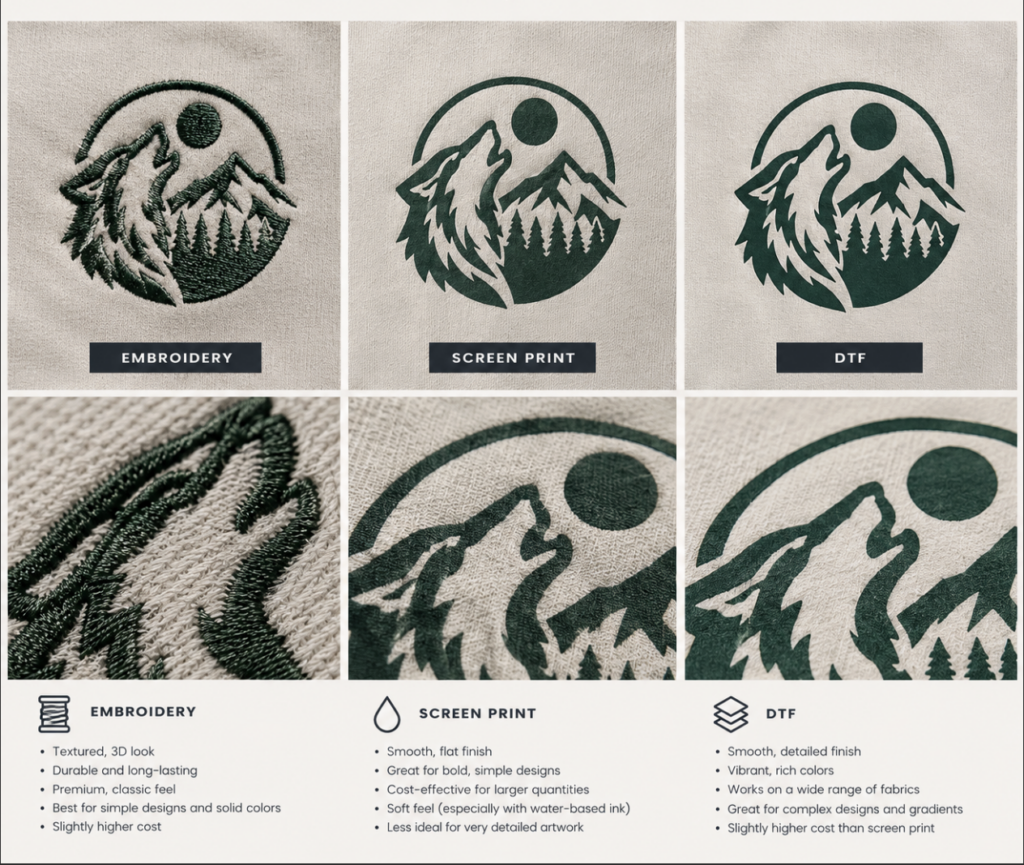
Reading that embroidery “looks premium” or DTF “handles gradients” only gets you so far. You want to see your logo stitched into a cap next to the same logo printed on a tee.
That’s what a mockup does, and it beats ordering three physical samples. Samples cost money and take days to ship. By the time they reach your client, the momentum is gone.
A photoreal preview takes seconds. You send three looks in one email and let the client point at the winner.
Dynamic Mockups covers every method in one browser tab. Our Stitch AI turns flat artwork into a realistic embroidery preview, thread texture and all, while the same design drops onto screen-print and DTF-style blanks for a fair side-by-side.
Showing a whole catalog? You can preview an entire product line the same way, then hand the client one tidy set of visuals instead of a stack of sample boxes.
If you’re weighing tools, we rounded up the best embroidery mockup generators and wrote a walkthrough on how to make an embroidery mockup online. Both stay neutral on which decoration method you should actually order.
Which Method Wins by Product and Quantity
Skip the theory. Here’s what to pick for the jobs you’ll actually quote.
By product:
- Caps and beanies: embroidery, almost always. It suits the structured fabric and reads as premium.
- Tees and hoodies: screen print at volume for simple art, DTF for low-count or full-color designs.
- Tote bags: screen print for bulk event bags, DTF for detailed one-offs.
- Polos: usually embroidery for the logo, by convention and for the look.
Embroidery vs DTF for hats. On a cap, embroidery wins most of the time. It handles the curved, structured front well and lasts for years.
Reach for DTF on a hat only when the design is photographic or packed with colors that would run up an embroidery stitch count, and the bill with it. On a flat-front trucker or a thin performance cap where stitching can pucker, DTF or a woven patch can be the smarter call.
So the embroidery vs DTF hat question comes down to the art: a logo or simple mark, stitch it; a photo or gradient, print it.
And you don’t have to pick just one. An embroidered left-chest logo paired with a large DTF or screen-printed back print is common, and it often looks more considered than forcing a single method to do everything.
By quantity:
- 12 pieces: DTF or embroidery. Low setup keeps small orders sane.
- 48 pieces: depends on color count. Simple art leans screen print, busy art leans DTF.
- 144 pieces: screen printing for simple designs, hands down.
Adding decoration to your shop? Our guide on how to start offering embroidery in your print shop covers the gear and the math. And you can preview an embroidered hat mockup from your logo before you commit to a single blank.
How Dynamic Mockups Shows Every Method for Free
You shouldn’t have to guess how a design lands on a product, or pay for three sample runs to find out.
Dynamic Mockups gives you 100,000+ free mockup templates across apparel, caps, bags, and more, so you can preview embroidery, screen print, and DTF looks in one place.
Our Stitch AI builds a realistic embroidery preview from flat art in seconds, and you can turn a logo into embroidery without opening Photoshop.
💡 Pro tip: Generate an embroidery mockup to get client sign-off, then export a ready-to-stitch DST file for your machine. Or drop the same artwork onto a plain tee to compare the screen-print and DTF look before you buy a single blank.
One design, every method, zero sample orders.
Start previewing your next design as embroidery, screen print, and DTF for free. →
Frequently Asked Questions
Is embroidery more expensive than screen printing?
It depends on quantity and design. Screen printing is cheapest for large runs of simple, low-color art because the setup spreads across more shirts. Embroidery is priced by stitch count, so its per-piece cost stays flatter and barely drops with volume. At around 12 pieces embroidery often wins; at 144 pieces simple screen print pulls ahead.
Is DTF cheaper than embroidery for small orders?
Usually yes. DTF has little to no setup, no screens and no digitizing, so a run of 12 carries no big upfront penalty. Expect roughly $3 to $7 per piece at that count, often below embroidery. Embroidery adds a one-time digitizing fee, then bills by stitch count on every piece, which keeps small-batch prices higher for detailed logos.
Which lasts longer: embroidery, screen printing, or DTF?
Embroidery lasts longest. It uses thread instead of ink, so it survives years of washing and heavy wear better than almost anything. Screen printing on cotton is close behind when the ink is cured properly. DTF performs well too but can crack or peel under heavy wear over time, which durability tests flag as its main weak point.
Is embroidery or DTF better for hats?
Embroidery wins on most caps. It handles the curved, structured front well, reads as premium, and lasts for years. Reach for DTF only when the design is photographic or packed with colors that would balloon an embroidery stitch count. On flat-front truckers or thin performance caps where stitching can pucker, DTF or a woven patch can be the smarter call.
What is the minimum order for screen printing versus DTF?
Screen printers usually want a floor of 12 to 24 pieces to justify cutting the screens, since each color needs its own setup fee. DTF has no such minimum. With little to no setup, it happily takes tiny runs, single pieces, or one-offs. That low barrier is exactly why DTF is the small-order favorite for full-color designs.
![How to Make an Embroidered Hat Mockup From Your Logo [2026]](https://dynamicmockups.com/wp-content/uploads/2026/08/embroidered-hat-mockup-cover-768x403.png)