


![What Is a DST File? How to Open and Use It [2026 Guide]](https://dynamicmockups.com/wp-content/uploads/2026/08/what-is-a-dst-file-cover-768x403.png) Embroidery
Embroidery
On this page
Can ChatGPT Make an Embroidery File? The Short Answer
Can ChatGPT make embroidery files? It can draw embroidery-style artwork and describe stitch settings in convincing detail, but it cannot write a machine file like DST, PES, or EXP that an embroidery machine will actually sew. It gives you pixels and paragraphs, not the stitches a needle follows.
The confusion is fair. ChatGPT now generates images on demand, so asking it for a sewable file feels like it should work the same way. A picture and a stitch file are two different kinds of things.
Here is the gap in plain terms.
A chat model outputs an image or a block of text. An embroidery machine needs something completely different: stitch coordinates, thread paths, a stitch order, and an underlay plan that anchors the fabric before the top stitches go down.
ChatGPT produces none of that. So the two questions people usually ask both land in the same place.
Can ChatGPT create a DST file? No. Can ChatGPT digitize an image into stitches on its own? Also no.
A DST file holds no picture. It is a set of commands that guide the needle, covering stitch direction, sequence, and placement, written for a machine to read and execute. A language model has no way to generate that data.
DST, PES, and EXP are not swap-ins for a JPG or PNG. DST is the near-universal Tajima format, PES is what most Brother machines read, and EXP turns up on other brands. Each one stores stitches, not pixels. If you want the full rundown, here is which format every embroidery machine brand uses.
The job belongs to a digitizer, either a trained human or an AI digitizer built for the task. If you want the full picture of how digitizing turns artwork into stitches, we cover that separately.
For now, the headline holds: ChatGPT can start the design, but it does not finish the file.
We Asked ChatGPT for an Embroidery File: Here’s What Came Back
We ran the test so you do not have to. Here is the exact prompt we pasted in:
“Create a DST embroidery file of a small fox-head logo, two thread colors, ready for me to download and sew onto a cap.”
What came back was a DST file preview, but an PNG image and not the DST file that can be sewn.
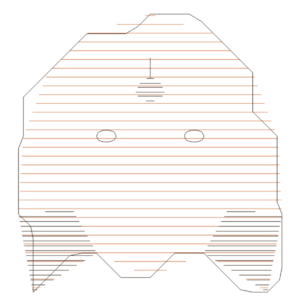
What it did not do was attach a.dst or.pes file. When we pushed, it said plainly that it cannot produce a machine-ready embroidery file and pointed us toward digitizing software.
Here is the part that trips people up.
Alongside the image, ChatGPT listed thread colors, stitch types, even a rough stitch count. It named satin for the outline, fill for the solid shapes, and a tidy two-color palette. It reads like a real digitizing spec.
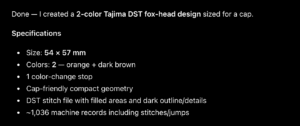
None of it carries stitch data.
Those are words describing stitches, not the coordinates a machine follows. The spec is a suggestion, and the image is just an image.
The rough stitch count had no basis either. With no stitch plan behind it, that number is a guess dressed up as a measurement.
We also asked it to skip the picture and just export the.dst. It could not. The best it managed was the written breakdown again, or a file that was really text with a new extension, the kind of thing a machine refuses to open.
You will also find custom GPTs and plugins that promise embroidery files, and some do deliver a real download. Look closely and they are digitizing engines bolted onto the chat window, doing the stitch work that ChatGPT on its own does not. That is the tell.
If that pattern feels familiar, it is the same thing we found in our sibling test on whether ChatGPT can make product mockups: a convincing picture that still is not the production file the job needs.
From ChatGPT PNG to a Real DST: We Ran It Through Stitch AI
The PNG is not useless. It is a starting point.
So you can take any PNG and drop it into our Image to Embroidery tool, which runs on our Stitch AI engine. This is where artwork becomes a file.
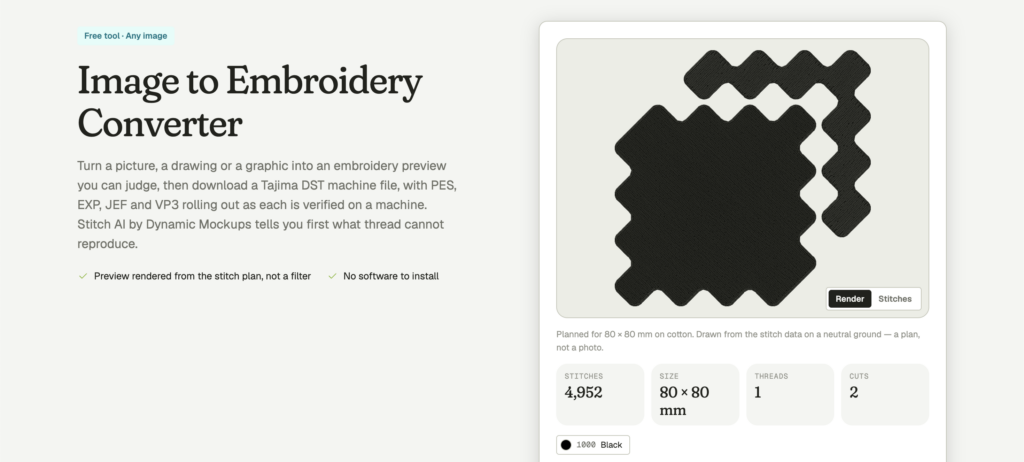
Stitch AI read the image and generated a thread-by-thread stitch preview, showing the real paths the needle would take instead of a flat picture. It returned an actual stitch count. And it gave us a downloadable DST, the one thing ChatGPT could not hand over.
We could also see the stitch density, the color stops, and where the machine would trim and jump between shapes. A flat PNG never carries any of that.
The whole process runs in the browser.
That DST is the file your machine opens and sews. If you want the format detail, we break down what a DST file actually stores, from stitch commands to thread stops and color changes.
The same design can export in more than one format, so you are not locked to DST. Need PES for a Brother machine, or EXP for another brand? Pick the format your hardware reads and download that instead.
What used to mean hours in desktop software, or a paid digitizing order with a turnaround time, happened in one pass in a browser tab.
💡 Pro tip: Check the stitch preview before you download anything. Stitch AI shows the needle paths and the color sequence, so you catch a messy fill or a stray jump stitch on screen instead of on the garment.
One upload turned a chat-generated picture into a stitch plan. That is the step the chatbot skips.
What We Had to Change Before It Would Sew Clean
The first pass was close, not perfect. A ChatGPT image is built for a screen, and screens forgive things thread does not.
We lined the image up against the same rules a human digitizer works to, and a few things had to change.
Here is what the design needed before it would sew clean:
- Sharp edges: Soft, fuzzy outlines confuse stitch placement, so every edge had to be crisp.
- No gradients or shadows: Thread cannot fade the way pixels do, so blended areas had to become solid blocks of color.
- A smaller color palette: We cut the color count so the machine was not stopping to re-thread every few seconds.
- An underlay: A base layer of stitches that holds the fabric and stops the top stitches from sinking or puckering.
Each fix maps to a real embroidery limit. Skip the underlay and even clean artwork can pucker, gap, or sink into the nap of a towel or a fleece.
Printful’s own guidance makes the point: its machines use a fixed set of thread colors, and it recommends against gradients or more than six colors per design. When a design does not fit the rules, digitizers thicken thin lines, simplify small details, and swap colors for supported threads.
Fewer colors is not only about looks. Every extra color is another thread change, another trim, another chance for the run to stall, and that adds time and cost to every piece you sew.
Tiny text and fine detail are the usual casualties. At stitch scale, they turn to mush.
Lettering has a floor. Very small or very thin type will not hold as satin stitches, so tiny text has to get bolder or go.
A garment decorator puts it well: embroidery recreates artwork with thousands of stitches, so tiny details, gradients, and very thin lines have to be simplified before they will stitch at all.
This is judgment work, and it is easy to get wrong. We keep a running list of the common embroidery digitizing mistakes that sink a stitch-out.
And it is exactly the step ChatGPT skips. It hands you a picture and calls it finished.
Where ChatGPT Fakes the Stitches: Embroidery Mockup Prompts
There is a second way people try to use ChatGPT here: the embroidery mockup prompt.
You have seen the output. Ask for “a photorealistic embroidered patch” or “a hoodie with a stitched chest logo” and it paints a lovely, textured image. Raised thread, little highlights, soft shadow, the works.
Every one of those stitches is drawn, not sewn.
The giveaway is uniformity. Real satin stitches catch light along their direction and leave tiny gaps at tight curves, while an AI render smooths all of that away into a perfect, impossible finish.
The texture is a painting of embroidery. It is not built from a stitch file, so there is nothing to send to a machine. Worse, it often shows detail no real stitch-out can reach, which sets a customer expectation you cannot meet on the product page.
That gap tends to surface later as refunds and sour reviews. A buyer who ordered the crisp, glossy patch from your mockup opens the package to a simpler stitch-out, and the complaint lands on your shop, not on ChatGPT.
Printful warns about this directly.
Embroidery thread does not behave like ink, so complicated references need real editing before they become patterns. And because a drawn mockup is not digitized, Printful notes the digitization preview will always be more accurate than the mockup.
So a faux-embroidery image is fine for a moodboard and risky for a listing. Used as inspiration, those renders are genuinely handy for planning a collection or pitching a client.
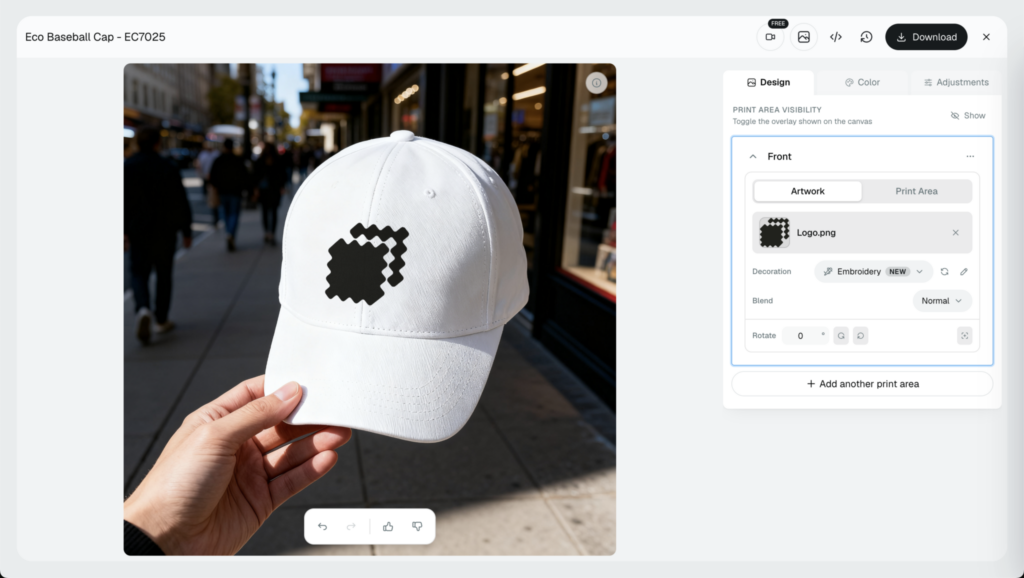
If you want a preview that matches the real result, build it from the real file. That is the whole idea behind a real embroidery mockup workflow: digitize first, then mock up the true stitch-out.
How to Get a Real Embroidery File From Any Design (Free)
Here is the workflow that actually ends in a file your machine can read.
- Start with a design. From ChatGPT, from your own artwork, from anywhere.
- Run it through an AI digitizer. This is the step that creates stitch data.
- Check the stitch preview. Confirm colors, detail, and stitch count before you commit thread.
- Download the DST. Load it on the machine and sew.
That loop works for almost anything you sell: caps and beanies, left-chest logos, patches, tote bags, and towels. The design can come from a chatbot, a designer, or a doodle on a napkin. The digitizer is what makes it sewable.
Two free tools do the heavy lifting. Our Image to Embroidery tool turns a finished picture into a stitch file. For logos, lettering, and simpler art, the AI Embroidery Digitizer does the same with settings tuned for clean text and small shapes.
Both run in the browser, and both are free to try with no credit card required.
ChatGPT is a fine place to sketch an idea. It is not the place to make the file. Bring the picture, let the digitizer write the stitches, check the preview, and download the DST.
Keep learning: the digitizing guide and DST breakdown linked above go deeper on the how and the format.
Turn your next design into a real, sewable stitch file for free, no credit card required.
Showcase your products like the big brands, without costing a fortune. Sign up today. No credit card required.
Frequently Asked Questions
Can ChatGPT create a DST file for embroidery?
No. ChatGPT can draw embroidery-style art and describe stitch settings, but a DST file holds stitch coordinates, thread paths, and a stitch order, not pixels. A language model has no way to write that data. We tested it: it returned a PNG and a written spec, then said plainly it cannot produce a machine-ready file.
Can ChatGPT digitize an image for embroidery?
Not on its own. Digitizing means converting artwork into stitch data, with stitch direction, sequence, density, and underlay. ChatGPT only outputs images and text, so it cannot do that step. Some custom GPTs and plugins deliver a real download, but look closely and they are digitizing engines bolted onto the chat window doing the actual stitch work.
What file format does an embroidery machine actually need?
A stitch file, not an image. DST is the near-universal Tajima format, PES is what most Brother machines read, and EXP turns up on other brands. Each one stores stitch commands, thread stops, and color changes, not pixels. A JPG or PNG will not load. Pick the format your specific hardware reads, then export that.
Is there an AI embroidery generator that exports a real stitch file?
Yes. An AI digitizer reads your artwork and writes true stitch data, then hands you a downloadable file. We dropped a ChatGPT PNG into our free Image to Embroidery tool, built on Stitch AI, and got a thread-by-thread preview plus a real DST. It runs in the browser, exports DST, PES, or EXP, and needs no credit card.
Why won’t my ChatGPT embroidery design stitch properly?
Because screen art breaks embroidery rules. Soft edges, gradients, shadows, too many colors, and tiny text do not survive in thread. A clean stitch-out needs crisp edges, solid color blocks, a trimmed palette, and an underlay that holds the fabric. Run the design through a digitizer, check the stitch preview, and fix messy fills or stray jumps before you sew.
![How to Make an Embroidered Hat Mockup From Your Logo [2026]](https://dynamicmockups.com/wp-content/uploads/2026/08/embroidered-hat-mockup-cover-768x403.png)