



![How to Start Offering Embroidery in Your Print Shop [2026]](https://dynamicmockups.com/wp-content/uploads/2026/08/how-to-start-offering-embroidery-cover-768x403.png) Embroidery
Embroidery
On this page
How Do You Price Embroidery by Stitch Count?
To price embroidery by stitch count, take the stitch count in thousands, multiply it by your per-1,000 rate, add the cost of the blank garment, then add a one-time setup or digitizing fee. On large runs, add a small machine-wear allowance per piece. Minimums apply to tiny orders, and the setup fee drops off on reorders.
Here’s the formula you can copy:
(stitch count / 1,000) x rate + blank + setup
An 8,000-stitch logo at $1.50 per 1,000 stitches is $12 of stitching, plus whatever the shirt costs you, plus a setup fee the first time you run the design.
That setup fee covers digitizing the logo into a machine file. Once the file is saved, reorders skip it, so your repeat price drops and your margin goes up.
Shops price this way because it’s fair in both directions. A simple logo costs the customer less, a dense one costs more, and the number is tied to real machine time instead of a gut feel.
One caveat before the details. Most shops set an order minimum, often $15 to $25, so a single small patch isn’t billed at a few dollars and a loss.
That’s how to charge for embroidery without guessing or leaving money on the table. The rest of this post unpacks each variable, publishes current 2026 rate ranges with sources, and runs two real quotes end to end.
If you’re weighing embroidery as a new service, start with how to start offering embroidery in your print shop, then come back to price it.
Let’s break down the variables.
The Stitch-Count Pricing Formula, Variable by Variable
Each piece of that formula pulls from a different place. Keep them separate and your quotes stay fast and easy to defend.
Stitch count: This is the real number, and it comes from the digitized machine file, not a guess. When a logo is digitized, the software outputs the DST machine file and its production sheet, and that sheet lists the exact stitch count. Price the actual count, because eyeballing a logo and calling it “about 10,000” is how shops lose money on dense fills.
Per-1,000 rate: This is what you charge per thousand stitches. It sits around $1 to $3 per 1,000 for most work, and it drops as quantity climbs, because setup spreads over more pieces and the machine runs the same file again and again.
To set your own rate, start from the hourly number you need to clear, then divide it by how many thousand stitches your machine sews in that hour. That gives you a floor to price above.
Blank cost: The cap, polo, or tee is its own line. Take what you pay for the garment, add your markup, and keep it out of the stitch math. Blend them together and you hide your real margin on each side.
Keeping the blank separate also lets you swap garments without redoing the stitch quote. The logo price holds whether the customer picks a $4 tee or a $14 quarter-zip.
Setup and digitizing fee: Digitizing turns artwork into a stitch file, and it’s a one-time cost per design. You can see how embroidery digitizing works for the full process, but for pricing the rule is simple: charge it once, then waive it on reorders because the file is stored. That reorder discount is the easiest loyalty tool you have.
Machine-wear and run-time allowance: Longer runs mean more hours on the machine, more needle and thread wear, and more maintenance. A commercial machine runs roughly 20,000 to 30,000 stitches per hour, so a big order ties up real production time. Build a few cents per piece into large runs to cover it.
2026 Embroidery Rate Ranges and Pricing Chart (With Sources)
Here are the numbers shops are actually charging, current for 2026. Treat them as a starting point you adjust to your market, not fixed law.
The customer-facing rate for stitching sits at $1 to $3 per 1,000 stitches. That range shows up across the industry, and the pricing guide at MaggieFrames notes it’s confirmed by Ricoma, Fash.com, and Corporate Casuals.
The embroidery digitizing cost runs about $1.50 to $2.00 per 1,000 stitches, with many services billing a flat minimum for small files. MIG Digitizing lists $1.50 per 1,000 stitches and an $8 minimum for designs up to 5,000 stitches.
A per-order embroidery setup fee commonly lands between $5 and $10. MaggieFrames uses $7.50 as a typical setup fee in its own worked example.
Keep those two fees straight. Digitizing is the one-time cost of building the file, and it disappears on reorders. The setup fee covers hooping and thread changes on a given run, so some shops keep a small version of it on every job.
Now the embroidery pricing chart. The sample charge below is stitching only, before the blank and the setup fee.
| Order type | Pieces | Stitch range | Per-1,000 rate | Sample stitch charge |
|---|---|---|---|---|
| One-off or sample | 1-5 | 5,000-10,000 | $2.00 | 8,000 st = $16.00 |
| Small batch | 6-10 | 5,000-10,000 | $1.75 | 8,000 st = $14.00 |
| Dozen caps or shirts | 11-20 | 5,000-10,000 | $1.50 | 7,000 st = $10.50 |
| Bulk or wholesale | 21+ | 10,001+ | $1.00 | 11,000 st = $11.00 |
Those tiered rates track the volume tables published by MaggieFrames, where the per-1,000 price steps down as both stitch count and quantity rise.
Two caveats on the chart. Rates shift by region, and urban shops often charge 20 to 30 percent more than rural ones, per MaggieFrames. Caps, thick fleece, and awkward placements can also carry a small upcharge over a flat left-chest logo.
Use the chart as a floor and adjust up. It’s a reference, not gospel.
Two Worked Quotes: A 12-Cap Order and a 48-Polo Order
Ranges are fine until a customer wants a number. Here’s the full math on two common orders, built from stitch counts pulled straight off the production sheet. Each total is rounded to a clean number a customer will actually accept.
The 12-Cap Order
A customer wants 12 structured caps with a left-chest-sized logo on the front. The digitized file comes back at 7,000 stitches. This is what it costs to embroider a hat in practice.
At 12 pieces you’re in the 11-20 band, so the rate is $1.50 per 1,000.
- Stitching: 7 x $1.50 = $10.50 per cap
- Blank cap with markup: $7.00
- Per-cap subtotal: $17.50
Twelve caps at $17.50 is $210. Add a one-time charge of $15 to digitize the logo and set up the first run, and the first order comes to $225, or $18.75 per cap.
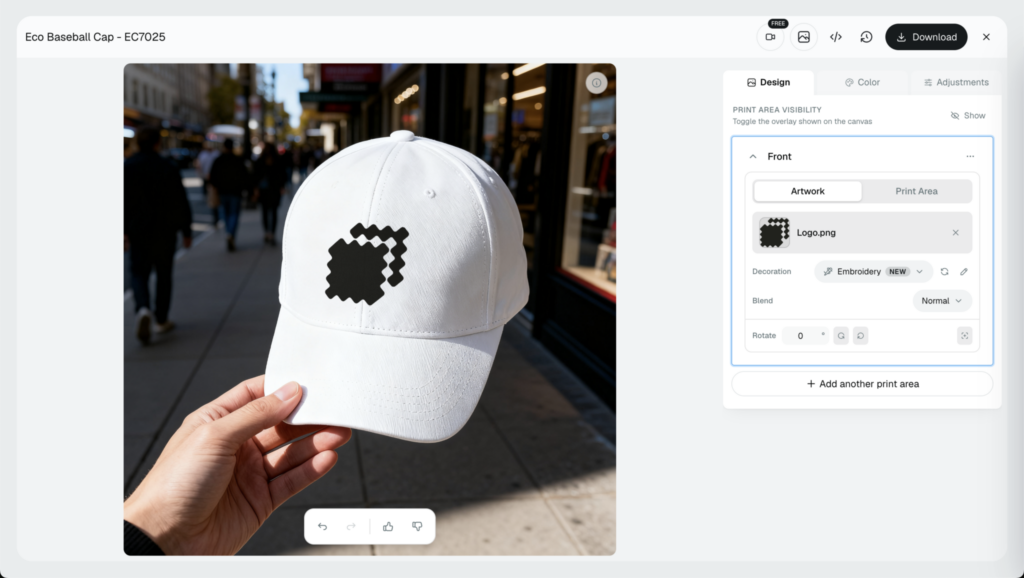
That’s the price the customer sees. Before you send it, proof the design as an embroidered hat mockup from your logo so they approve the look before a needle touches thread.
Now the reorder.
The file is saved, so the $15 drops off. The same 12 caps come to $210 flat, $17.50 each. Same stitching, better margin, zero new setup work.
The 48-Polo Order
This time it’s 48 polos with a more detailed left-chest logo at 11,000 stitches.
Two things pull the rate down at once: the higher stitch count and the bigger quantity. At 48 pieces with an 11,000-stitch design you land in the 21-plus, 10,001-plus band at $1.00 per 1,000.
- Stitching: 11 x $1.00 = $11.00 per polo
- Blank polo with markup: $12.00
- Per-polo subtotal: $23.00
Forty-eight polos at $23.00 is $1,104. Digitizing and setting up the logo once at $20 brings the first order to $1,124, about $23.42 per polo.
Spread across 48 pieces, that one-time fee is only 42 cents each. On the 12-cap order it was $1.25 a cap. The more pieces you run, the thinner setup gets.
The reorder drops the $20 entirely: $1,104, or $23.00 per polo. On a run this size, also fold a few cents per piece into your rate for machine wear, since 48 polos at 11,000 stitches is more than half a million stitches of run time.
When Flat and Hybrid Pricing Beat Per-Stitch
Per-stitch is precise, but it’s not always the fastest way to quote. Two other models earn their place.
Flat pricing is a single catalog price per item, with setup and stitching baked in. It suits web stores and retail counters with simple logos, where customers want to see a price, not do math. A left-chest logo on a shirt commonly retails at $15 to $40 including the garment, per Fash.com, so pick your tiers and publish them.
The risk with flat pricing is dense art. If one customer’s logo runs 14,000 stitches at your 8,000-stitch flat rate, you quietly eat the difference on every piece.
Hybrid pricing blends the two: flat price bands sorted by stitch range. A logo up to 8,000 stitches is one price, 8,001 to 15,000 is the next, and so on. Ricoma recommends moving away from pure per-stitch toward a flat, hourly, or hybrid model for exactly this reason, since it keeps quoting fast while still respecting the stitch count.
So when does per-stitch win? Three cases:
- Complex art: when stitch counts swing so wide that a flat price would overcharge simple jobs and lose money on detailed ones.
- Large runs: when small per-1,000 differences add up and the quote should reflect real machine time.
- Wholesale and contract work: when buyers expect to see the stitch math and compare it line by line.
A quick rule for picking fast: flat for your webstore and walk-ins, hybrid for most quoted jobs, per-stitch for bulk and contract. Your embroidery margins follow the same logic as the rest of your catalog, so it pays to price your print-on-demand products with one consistent method across the shop.
How to Get a Stitch Count Before You Quote
Every number in this post depends on one thing: an actual stitch count. No file, no count, no quote.
If the design isn’t digitized yet, you don’t have to send it out and wait on a vendor. Our free Image to Embroidery converter turns a logo into a DST file in the browser and returns the stitch count you plug straight into the formula above. You skip the outside vendor and the two-day turnaround entirely.
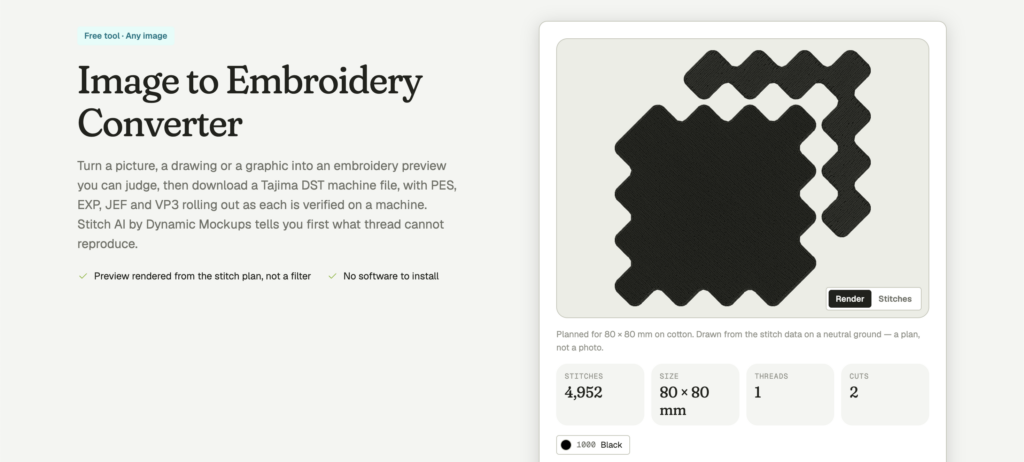
From there, proof the result before anything is sewn. Make an embroidery mockup online to show the customer a photoreal embroidered preview, collect the sign-off, and avoid remakes.
Then save the DST. The next time that customer reorders, the file is ready and the setup fee is gone, so you quote the whole job in seconds.
Pull a stitch count, proof the look, and send a real number the same day.
Showcase your embroidery like the big brands, without costing a fortune. Sign up today. No credit card required.
Frequently Asked Questions
How much do you charge per 1,000 stitches for embroidery?
Most shops charge $1 to $3 per 1,000 stitches, with the rate dropping as quantity climbs. A one-off sits near $2.00, a dozen caps around $1.50, and bulk work down near $1.00. Setup spreads over more pieces on big runs, so the per-1,000 price falls. Price the actual stitch count from the file, never a guess.
How do you find the stitch count for an embroidery design?
The stitch count comes from the digitized machine file, not your eye. When artwork is digitized, the software outputs a DST file and a production sheet, and that sheet lists the exact count. If the design isn’t digitized yet, an AI embroidery digitizer can turn a logo into a DST and return the number in seconds. Never eyeball it, because dense fills cost you money.
What is a typical embroidery setup or digitizing fee?
Digitizing usually runs $1.50 to $2.00 per 1,000 stitches, with many services billing a flat minimum around $8 for small files. The per-order setup fee is separate and commonly lands between $5 and $10. Digitizing is a one-time cost that disappears on reorders once the file is saved. Setup covers hooping and thread changes, so some shops keep a small version on every job.
Is it better to price embroidery flat or by stitch count?
It depends on the job. Flat pricing works for your webstore and walk-ins, where customers want a number, not math. Per-stitch wins for bulk, contract, and complex art, where stitch counts swing wide. Many shops use a hybrid: flat price bands sorted by stitch range. Pick one consistent method so simple logos don’t overcharge and dense ones don’t quietly eat your margin.
How much should I charge to embroider a hat?
Price it like any stitch job: stitching plus the blank cap plus a one-time setup. Take a 7,000-stitch left-chest logo at $1.50 per 1,000, that’s $10.50 of stitching, add roughly $7 for the cap with markup, and you’re at $17.50 per cap. A dozen caps runs about $210 plus a $15 setup the first time. Reorders drop the setup entirely.
![What Is a DST File? How to Open and Use It [2026 Guide]](https://dynamicmockups.com/wp-content/uploads/2026/08/what-is-a-dst-file-cover-768x403.png)