


 News
On this page
What Is an AI Mockup Agent?
An AI mockup agent is an assistant that takes a mockup request written in plain language, right inside a Slack or Microsoft Teams thread, and sends back finished, photorealistic product images. You describe what you want in an ordinary message. It replies with the mockups.
The reply is the finished thing: images you can actually use, generated from a sentence you typed.
Trelium builds the agent. Dynamic Mockups powers the visuals. And a person reviews every reply before it goes out.
Trelium’s agent handles the conversation and the context, and our engine renders the product images behind it. Nothing lands in front of a buyer until a human has checked it.
A mockup is how someone sees a product before it exists. It’s the difference between “I think I get it” and “yes, make that.” So a request for one is really a request to move a decision forward.
We made a short film about that that you can see at the end of this blog article, about a minute and a half long, and it tells the whole story through one very ordinary request.
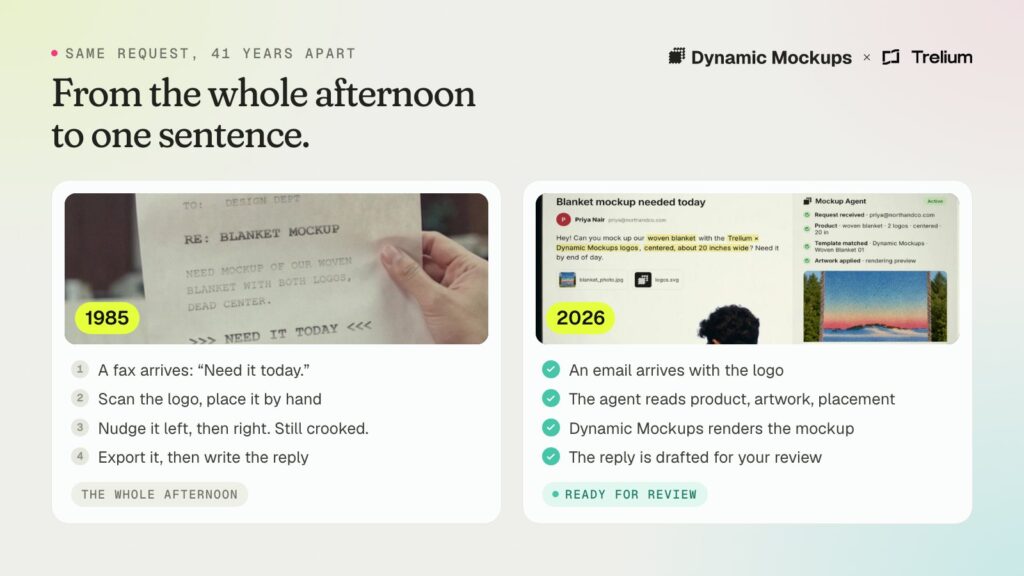
Picture that request twice, decades apart.
In 1985, it’s a fax stamped NEED IT TODAY, then an afternoon spent standing near the machine, hoping the proof comes back before everyone goes home.
In 2026, it’s the same ask, sent by email, and answered right there in the reply. Same request. Different century, different afternoon.
The thing being asked for hasn’t changed. Someone wants to see the product before they commit to it. What’s changed is where the request lives: it starts and ends in a chat thread.
If you’ve been following how AI agents are reshaping ecommerce, this is that shift landing on one specific job: product mockups. AI agents will account for $15 trillion in B2B purchases by 2028, according to Gartner, which means more of the people who buy and sell products will spend their day talking to agents. The visuals those agents hand back need to be good.
How a Mockup Agent Works: Five Steps
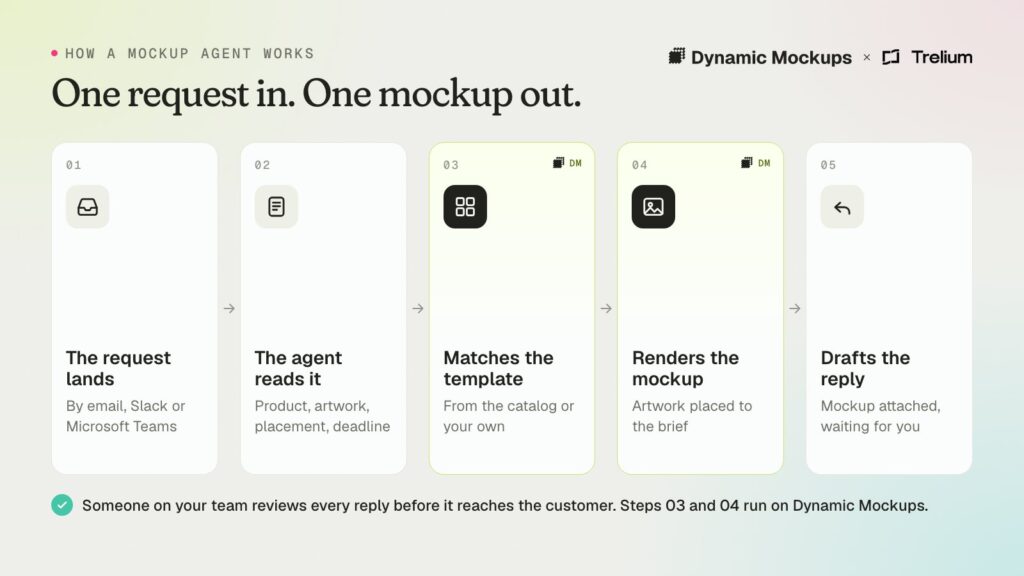
A request moves through five steps, from message to mockup. Two of them run on Dynamic Mockups, and one of them is always a person.
Here’s the full path, in order. None of it asks the person making the request to know anything about design software.
Step 1: Someone Sends a Request in Plain Language
A teammate or a buyer types what they want into Slack or Teams. There’s no form to fill in and no brief to format.
A line like “put our new logo on a white mug, centered, and show me a couple of angles” is plenty. The agent is built to read the way people actually write.
Step 2: The Agent Reads the Request
Trelium’s agent pulls the details out of that message: the product, the design, the placement, the colors, how many variations you want. It works out what you’re actually asking for before anything gets made.
If something’s missing, it can ask, the same way a good studio would check before starting.
Step 3: Dynamic Mockups Generates the Mockup
This step runs on us. Our visual engine takes the design, places it on the chosen product blank, and renders it as a photorealistic lifestyle image.
This is the part that used to mean opening Photoshop, lining up a smart object, and exporting. Here it happens in the background.
Step 4: Dynamic Mockups Returns the Finished Images
Also on us. The visual engine sends back finished product images, clean and photorealistic, framed and ready to drop into the conversation.
These are the actual images you’d put in front of a client or into a listing, not rough previews.
Step 5: A Person Reviews, Then the Reply Goes Out
Before anything reaches the person who asked, a human looks at the result. If it’s right, it goes back into the same thread as a reply. If it isn’t, it gets fixed first.
What comes back is usually a set of options, a few angles or color variations of the same product, so the person who asked can choose instead of squinting at one small thumbnail.
Changes in Plain Words: Revisions in a Slack or Teams Thread
First version not quite right? You don’t open a design tool to fix it.
You say what’s off, in the same thread, in the same plain language you used the first time. “A little bigger, a touch higher.” The agent comes back with an updated image.
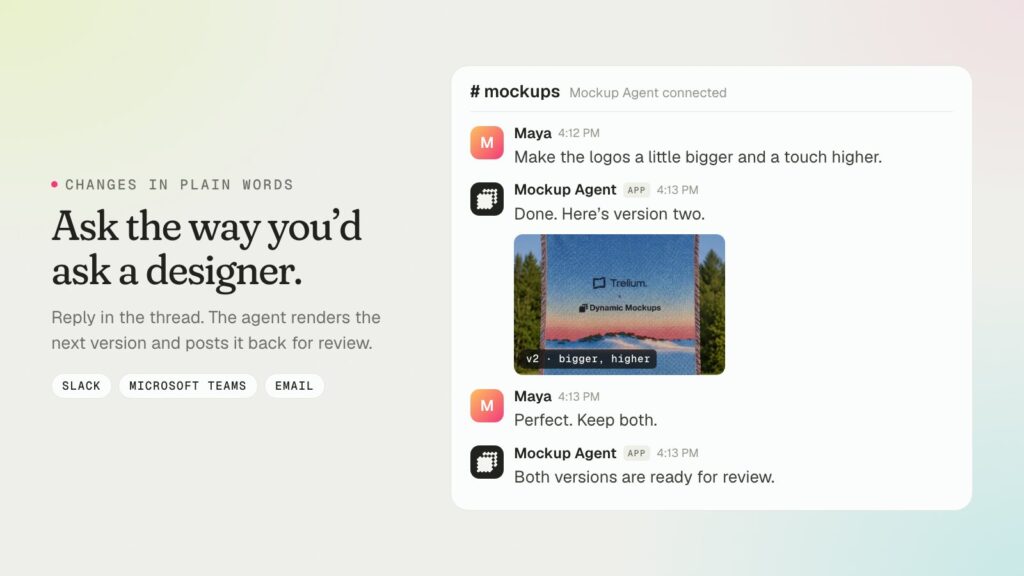
That’s the part that feels genuinely different from the old way.
There’s no design file to open, no layers to hunt through, no folder full of versions named final_v4.
You describe the change the way you’d describe it to a colleague across the desk, and the next version shows up in the chat. You keep going, a round at a time, until it’s right.
Say the buyer looks at the mug and decides the logo should sit on the left, in cream rather than white. You type exactly that. The new version comes back, and the earlier one is still sitting in the thread if anyone wants to compare the two.
For anyone who has managed a revision over email, with screenshots marked up in red and three people replying at once, the single-thread version is a relief.
What Mockup Agents Take Off Your Plate
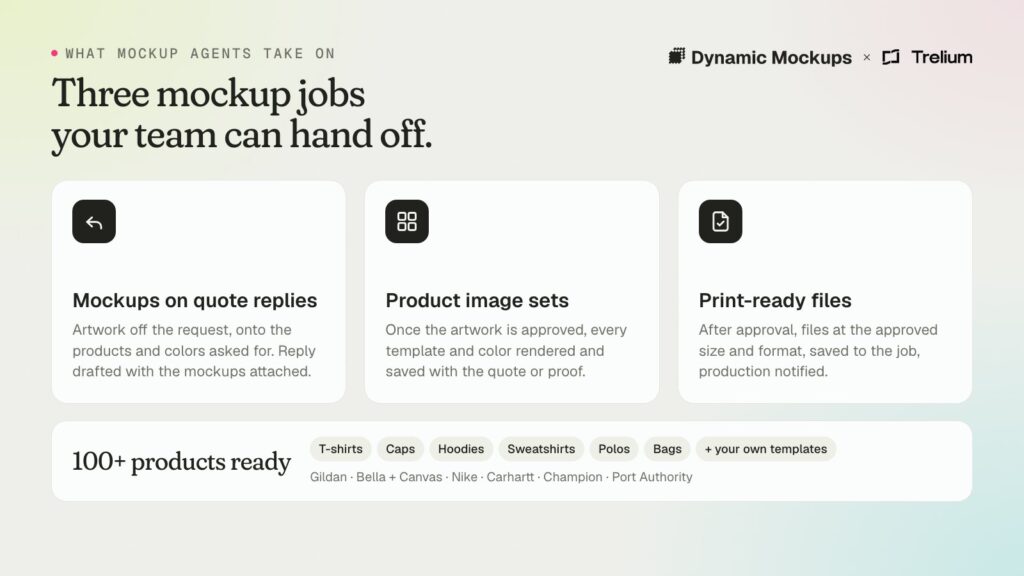
A Mockup Agent is built to carry the parts of mockup work that quietly eat your week. Three of them, specifically.
- Making each mockup by hand: no opening a design tool and rebuilding the same scene from scratch for every request that comes in.
- Running the revision rounds: the back-and-forth stays in the thread, in plain words, with no files to re-export and re-send each time.
- Producing mockups at volume: many products and many designs at once, so one person doesn’t become the bottleneck when a big request lands.
This helps the people who field mockup requests all day. Merch agencies pricing up a client’s order, print-on-demand sellers building out listings, promo distributors answering “can I see it on a navy one?” for the tenth time that morning.
You’re not limited to a handful of items either. There are 100+ ready products to choose from growing daily, and you can bring your own templates when you have a specific blank or brand item in mind.
It covers both sides of the merch world. Promotional products like branded mugs, tote bags, and water bottles sit right next to print-on-demand products like t-shirts, hoodies, and wall art.
Volume is where this earns its keep. A seasonal drop or a big client order can mean dozens of products that all need the same treatment, and that is exactly the kind of work that stacks up on one person.
About Trelium
Trelium is an independent company, and we work with them as a partner on the agent side of this.
They were formerly known as Questom, and they’re part of Y Combinator’s Fall 2025 batch. The company was founded by Ritanshu Dokania and Abhimanyu Yadav. Being in a current Y Combinator batch means they are early and moving quickly, with a tight focus on getting the agent right.
Their focus is the agent itself: reading requests, holding the context of a conversation, and managing the back-and-forth until the person who asked is happy.
To do that, the agent plugs into the tools teams already use to talk to each other. That means Slack, Microsoft Teams, email and other tools they integrate with. A request gets handled in the exact place it was already going to be written, instead of in yet another dashboard someone has to remember to open.
Trelium can build the best agent they can, and we can build the best visual engine we can, and the two meet in the middle.
Why We Partner This Way
Trelium builds the agents. We build the visual engine.
Trelium owns the conversation: the context, the request, the rounds of changes. We own the images that come out of it.
It means each side can keep improving on its own timeline. A better agent and a better visual engine both show up in the same chat window.
“We want to grow alongside the ecosystem, not around it,” says Luka, our founder. “As more buying and selling moves into chat and into AI agents, our job is to make sure the product visuals are right there with it. Partnering with teams like Trelium is how we do that.”
Our part is the visual engine: photorealistic product images, rendered fast. It’s the same engine behind real-time mockup rendering inside our own editor, where a design updates on the product as you type.
We like building this way, where our visuals slot into a tool people already use. It’s the same pattern behind our OneKlik DTF integration, where the mockups live inside a workflow sellers are already running rather than off to the side.
For the person on the other end, it just looks like they asked for a mockup and got one. The engineering that makes that happen stays out of view.
How to Get Started With Mockup Agents
Where you start depends on where you already are. There are three paths.
- Already a Trelium customer: the visuals inside your agent are powered by Dynamic Mockups, so there’s nothing new to switch on. It’s already working behind the replies you get.
- New to both: start with Dynamic Mockups on its own. It’s free to try, with no credit card required, and you can add a Trelium agent later when you want chat-based requests on top of it.
- A software or dev team: build straight against the visual engine with the mockup API, and wire our rendering into whatever you’re putting together.
Pick the path that fits you and go from there. The visual engine is the same underneath all three, so a shop can start simple and a dev team can go deep without anyone switching products.
For every product that needs to be seen, found, and sold.
Frequently Asked Questions
What is an AI mockup agent?
An AI mockup agent is an assistant that takes a mockup request written in plain language, inside a Slack or Microsoft Teams thread, and sends back finished, photorealistic product images. You describe what you want in an ordinary message, and it replies with usable images. With Mockup Agents, a person reviews every reply before it reaches you.
Who is Trelium, and were they formerly called Questom?
Trelium is an independent company and our partner on the agent side of Mockup Agents. Yes, they were formerly known as Questom. They are part of Y Combinator’s Fall 2025 batch and were founded by Ritanshu Dokania and Abhimanyu Yadav. Trelium builds the agent that reads requests and manages the back-and-forth, while Dynamic Mockups powers the visuals.
Does a person review every mockup a Mockup Agent creates?
Yes. Step five of the process is always a person. Before any reply reaches the person who asked, a human looks at the result. If it is right, it goes back into the same thread. If it is not, it gets fixed first. Every reply gets a human eye before it is sent.
What products can Mockup Agents make mockups for?
Mockup Agents cover both sides of the merch world. There are 100+ ready products to choose from, and you can bring your own templates for a specific blank or brand item. Promotional products like branded mugs, tote bags, and water bottles sit next to print-on-demand products like t-shirts, hoodies, and wall art.
How do I get started with Mockup Agents?
There are three paths. If you are already a Trelium customer, the visuals are already powered by Dynamic Mockups, so nothing new switches on. If you are new to both, start with Dynamic Mockups free, with no credit card required, and add a Trelium agent later. Dev teams can build straight against the mockup API.