


![Mockup API Rate Limits & Speed: 9 Questions Developers Ask [FAQ]](https://dynamicmockups.com/wp-content/uploads/2026/08/mockup-api-rate-limits-cover-768x403.png) Knowledge
Knowledge
On this page
How Fast Is the Fastest Mockup API?
The fastest mockup API renders 12.5 mockups per second. We proved it by rendering 750 mockups in 60 seconds, with a single MockAnything render clocking in at around 800 milliseconds, but using our Batch Mockup Render API to render them in parallel.
That is the number. If you came here to compare mockup APIs on raw speed, you can lift 12.5 mockups per second and go, or stay and see exactly what it measures.
The figure comes from our own custom-built rendering engine, the one that we have been building for years and not vibecoded in days, the one behind the MockAnything Render Mockup API. We built it in-house on purpose, so we could push throughput instead of renting someone else’s render farm and inheriting its limits.
One thing to be clear about. When we say “fastest,” we mean fully rendered lifestyle product mockups with real warp and curves, the kind where artwork bends around a mug or folds into fabric. And the product that is generated as that mockup is actually manufacturable – and not invented by AI image generators.
Not flat overlays. Not a browser screenshot of a device frame.
That distinction matters. A flat PNG dropped over a design is cheap to make and cheap to render. A photorealistic mockup that wraps artwork across a folded hoodie is a harder job, and 12.5 of those per second is a different class of result.
Here is why the number is worth planting a flag on. Search the space and you will find plenty of tools promising renders “in seconds.” Almost none publish a hard per-second figure you can hold them to. When tried in practice and in bulk, things start to crash.
“In seconds” is a soft claim. A five-second render is also “in seconds.” A published throughput number is not soft, and that is the point of this benchmark.
We wrote the number down so you do not have to guess at it. 12.5 mockups per second, 750 in 60, roughly 800 ms for one. Quote it, screenshot it, drop it into your vendor comparison and move on.
What the 750-in-60 Benchmark Actually Measures
Two numbers hide inside that benchmark, and they answer two different questions.
The first is single-render latency: about 800 milliseconds to turn one design into one finished mockup. That is the “how long do I wait for one image” number.
The second is sustained throughput: 12.5 renders per second, held steady across the full 750-image run. That is the “how many can I get in a minute” number, and it is the one most people actually need.
Throughput is not just single-render speed multiplied out. If one render takes 800 ms, a naive one-at-a-time loop gives you barely more than one per second.
Getting to 12.5 means the engine accepts many requests at once and renders them in parallel. That parallelism is the whole reason we built a custom engine instead of buying one.
And that can be achieved by using the Batch Render Mockups API.
Which number matters depends on what you are building.
Watching a shopper’s live preview update as they change a color? You care about the 800 ms.
Generating a season of listing images overnight? You care about the 12.5/sec.
Most APIs at scale run async anyway. You POST a job, then wait on a webhook or poll for the result. What you really want to know is how fast that queue drains, and that is throughput.
It also helps to know what “a render” contains here. Each one places a logo, a set of colors, and artwork onto a manufacturable lifestyle product mockup, then renders the full photorealistic image. Not a low-res preview you have to re-export later at print quality.
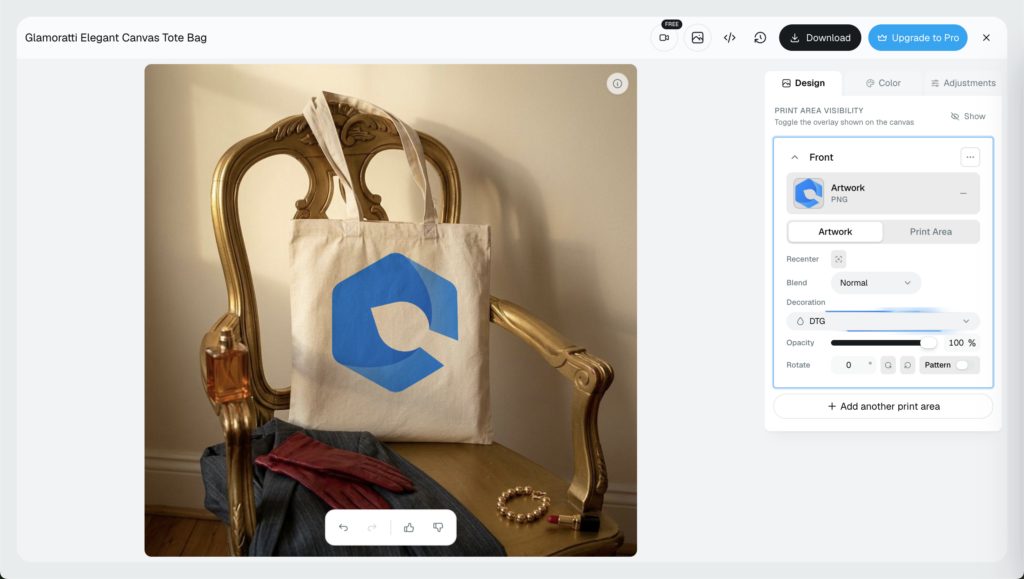
That detail is easy to skim past. Some tools reach a fast time by handing back a small or watermarked preview, then charging a second, slower call for the print-ready file. The benchmark here measures the finished image on the first pass.
This is where single-number comparisons get slippery. As one 2026 image-API benchmark points out, the real “time to image” depends on more than the raw render, since sync versus async responses and polling loops all change how long you actually wait. A published throughput figure cuts through that.
Want the concepts under all this, from endpoints to smart objects to output formats? Our complete guide to mockup APIs covers them without the benchmark noise.
Throughput vs Single-Render Speed: Why the Batch Number Wins
For a single mockup, 800 ms versus two seconds is a shrug. You will not feel the difference waiting on one image.
At volume, that same gap decides your whole afternoon and whether you will have your drink or meal on time.
Do the arithmetic on a real catalog. Say you have 300 designs and 30 products to place each one on. That is 9,000 listing images, and mockup rendering speed is the gate every one of them has to pass through.
At 12.5 per second, that batch clears in about 12 minutes. A service that needs several seconds per render has to fire up a lot of parallel workers to keep pace, and any worker that was asleep pays a cold-start tax before the first image even lands.
The single-render number barely moved. The batch number changed your day.
Agencies feel this first. A client approves a logo late Friday and expects the full product range mocked up by Monday. When every render is a coin flip on speed, that weekend gets long.
Demand is rarely smooth, either. A product drop or a viral post fires a burst of renders at once, and a slow engine backs up exactly when you can least afford it.
This is why throughput is the honest metric for anyone generating at scale. It is also why we tie the benchmark to catalog work instead of one-off renders.
If you produce that kind of volume through the dashboard rather than the API, the bulk mockup generator runs on the same speed-first engine: feed it a design set, get back a full catalog of mockups. It is effectively the fastest mockup generator we ship.
For a production example, our Matesy e-commerce speed case study shows what render speed looks like when it is wired into a live e-commerce operation.
The math is boring on purpose. Designs times products equals images, and images times render time equals your bottleneck. Speed is the one variable in that line you can actually buy back.
None of this is conversion math. It is the plain mechanics of how many images you can make before lunch.
Fastest Mockup API: Speed Benchmark vs Other Tools
So how does 12.5 per second sit next to the rest of the market? Here is the scoreboard, using each tool’s own published or self-reported figures.
| Mockup API | Published render speed | Custom PSD | Free entry |
|---|---|---|---|
| Dynamic Mockups (MockAnything Render API) | ~800 ms single, 12.5/sec sustained in batch mode | ✅ | ✅ Free plan |
| Mediamodifier | ~1.4-2.6s per render (self-reported) | ⚠️ mostly templates | ⚠️ paid API |
| MockCity | 5-10s per render, plus 15-20s cold start | ✅ | ⚠️ |
| SudoMock | Self-reported fast, no per-second figure, breaks on batch | ✅ | ✅ free dashboard |
A few notes, in fairness to everyone on the list.
Mediamodifier publishes its own speed test: eight parallel API renders landing between roughly 1.4 and 2.6 seconds each. That is respectable, and their template library is deep.
MockCity is built around custom PSDs, which is genuinely useful. Its own docs are upfront that workers sleep after a minute idle, take 15 to 20 seconds to wake, then 5 to 10 seconds per render.
SudoMock leans on low price and custom PSD support, and its own comparison table lists Dynamic Mockups at “2 to 4 seconds” per render. Which is not true and it is misinformation. A single MockAnything render is about 800 ms, and sustained output is 12.5 per second.
The table is not a hit piece. Use it to walk away with one defensible number to quote when someone asks which mockup API is fastest.
Looking for mockup APIs yourself? Ask two questions. What is the single-render time on a print-ready output, and what is the sustained rate across a few hundred back-to-back calls?
Most vendors can answer the first. The second is where the real differences show up.
Cold starts deserve their own line of questioning. A rate that only holds once the engine is warm is a best case, not a baseline, and bursty POD workloads spend plenty of time in the cold zone.
Custom PSDs are part of the speed story too, because a fast engine only helps if it renders the templates you actually sell on. Our custom Photoshop mockup support runs your existing smart-object PSDs through the same fast pipeline, so speed does not cost you the templates you already own.
However, even if the PSD templates can be really fast, MockAnything templates created in Dynamic Mockups are operating at extremely high speed.
12.5 per Second Is the Floor, Not the Ceiling
One more thing the benchmark does not say: that 12.5 is a hard limit.
It is the published baseline, the number we are comfortable putting in writing for the standard pipeline. The engine and the infrastructure behind it are built to scale.
For customers who need more, higher sustained throughput is available. As volume grows, the ceiling moves up with it rather than boxing you in.
Built to scale means something specific here. The engine can take on more parallel requests as your account needs them, so a busy launch week gets the headroom a quiet Tuesday does not.
So read 12.5 per second as a floor you can count on, with room above it for the businesses that outgrow it.
This is about speed headroom, by the way, not rate limits or quota settings. Those are a separate conversation, and they do not change how fast mockup generation itself runs.
How MockAnything AI and the Render API Deliver the Speed
The speed comes from two pieces working together, and it is worth seeing how they fit.
Step one is MockAnything AI. Feed the MockAnything AI API any flat product photo or type the prompt. A blank tote, a plain mug, a folded tee, and it turns that photo or prompt into a reusable, manufacturable lifestyle product mockup. The warp, curves, and shadows are mapped once, so your artwork sits on the surface like it was printed there.
Step two is the Render Mockup API. Once the mockup exists, the Render Mockup API drops in the logo, the colors, and the artwork and renders the finished image.
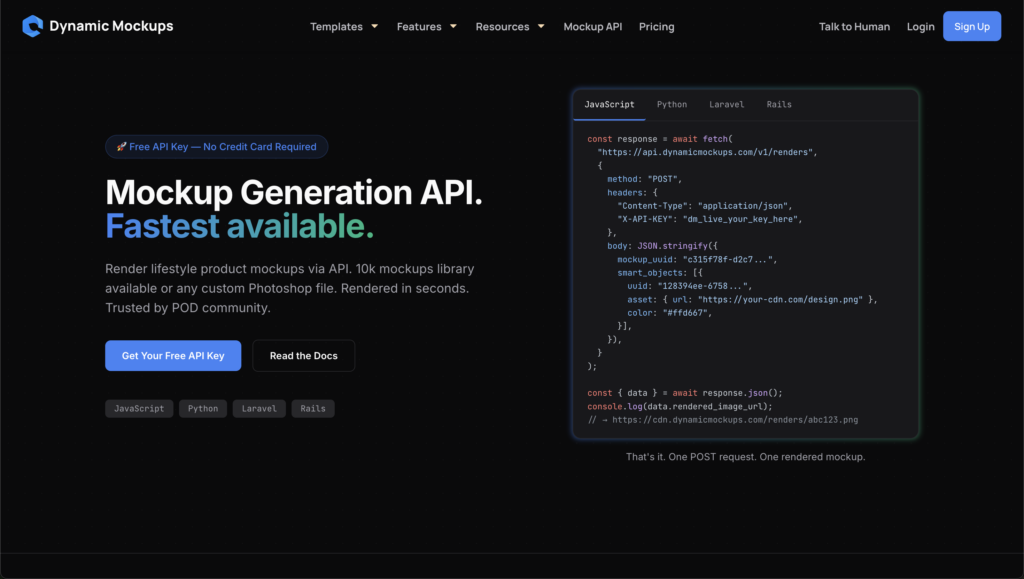
This is the stage the 750-in-60 benchmark measures, and where the 12.5 per second lives.
The split is what makes speed at scale possible. You build a mockup once with MockAnything AI, then hit it thousands of times through the Render Mockup API without redoing the hard part.
Picture a POD seller with one new hand-lettered design and 40 products to put it on. MockAnything AI builds those 40 mockups once. After that, every new design is 40 fast Render Mockup API calls, not 40 trips back into Photoshop.
That is the part that keeps paying off. The expensive step, mapping a photo onto a warpable surface, happens a single time per product. Everything after it rides the fast path.
Developers wiring this up will want the Render Mockup API reference for the endpoints and the MockAnything AI API docs for the mockup creation step from image or prompt. Both sit under our mockup generator API if you want the full picture before writing a line of code.
You do not need a Photoshop license or a render farm to get here. You need a design, an API key, and a few hundred milliseconds.
Start rendering with the fastest mockup API for free. →
Showcase your E-commerce products like big brands, without costing a fortune. Sign up today. No credit card required.
Frequently Asked Questions
What is the fastest mockup API available?
Dynamic Mockups is the fastest mockup API we know of that publishes a hard number. Its MockAnything Render API renders 12.5 fully photorealistic mockups per second, proven by 750 in 60 seconds. Most rivals promise renders in seconds without a per-second figure. A published throughput number is one you can hold a vendor to.
How many mockups per second can Dynamic Mockups render?
Dynamic Mockups renders 12.5 mockups per second, sustained across a full 750-image run through the MockAnything Render API. That is not single-render speed multiplied out. The engine accepts many requests at once and renders them in parallel, which is the whole reason we built a custom engine instead of renting someone else’s render farm. And 12.5 is the published floor, not a hard ceiling.
How long does it take to render a single mockup?
A single MockAnything render clocks in at around 800 milliseconds, and that is a finished, print-ready photorealistic image on the first pass. Not a low-res or watermarked preview you have to re-export later. It places a logo, colors, and artwork onto a manufacturable lifestyle mockup with real warp and curves, then renders the full image in under a second.
How do mockup API rendering speeds compare across tools?
Using each tool’s own published figures: Dynamic Mockups renders around 800 ms single and 12.5 per second sustained. Mediamodifier self-reports roughly 1.4 to 2.6 seconds per render. MockCity lists 5 to 10 seconds per render plus a 15 to 20 second cold start. SudoMock reports fast but publishes no per-second figure. When shopping, ask for single-render time and sustained rate across hundreds of calls.
Is 12.5 mockups per second the fastest it can go?
No. 12.5 per second is the published floor, the figure we are comfortable putting in writing for the standard pipeline. The engine and infrastructure are built to scale, so for customers who need more, higher sustained throughput is available. A busy launch week gets headroom a quiet Tuesday does not. Read 12.5 as a baseline you can count on, with room above it.