



![6 Best Clothing Mockup Apps to Try in 2025 [Review]](https://dynamicmockups.com/wp-content/uploads/2024/06/cover-3-768x403.webp) Tools & Alternatives
Tools & Alternatives
I was having a morning cup of coffee couple days ago when the news broke.
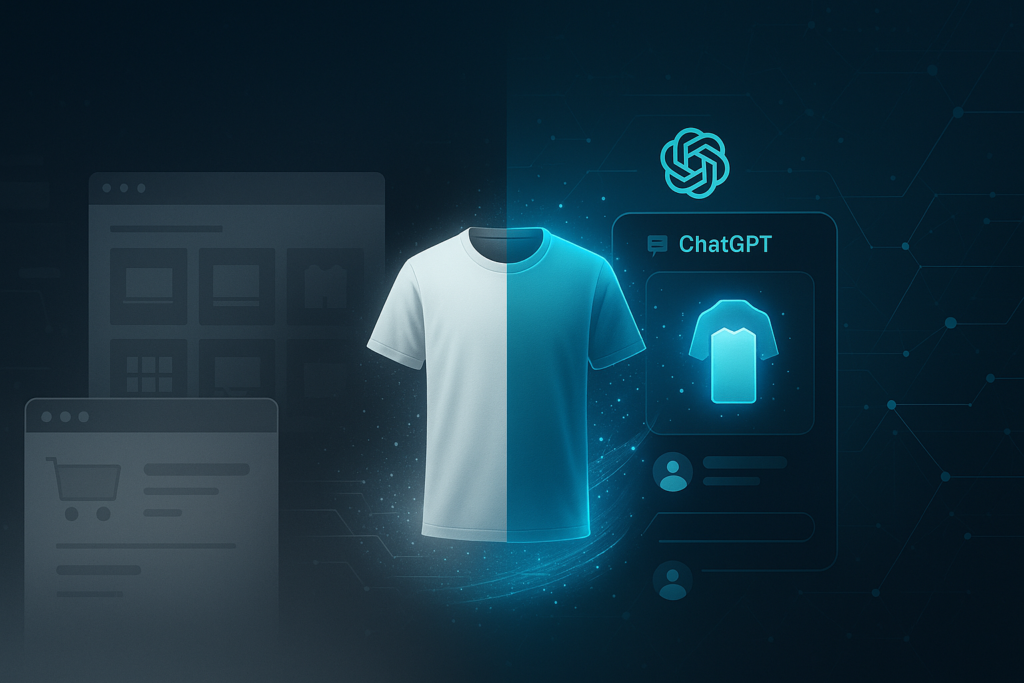
OpenAI quietly launched Instant Checkout in ChatGPT, enabling direct purchasing for 700 million weekly users.
While I was reading the announcement, I realized that this wasn’t just another AI feature update. I realised that we are watching the rebirth of e-commerce as we know it.
As a founder of Dynamic Mockups, I’ve spent years watching commerce evolution from the sidelines. But this shift is different.
This shift will changehow consumers discover, evaluate, and purchase products online.
And frankly, most business leaders still don’t understand what just happened.
For print on demand and e-commerce leaders, this presents both an existential threat and an unprecedented opportunity.
On this page
The Visual Revolution Everyone Missed
After diving deep into OpenAI’s announcement and Stripe’s technical documentation, I realized what everyone missed: the image literally becomes the store.
Traditional e-commerce relies on a complex dance of discovery: hero shots, detailed images, lifestyle photography, reviews, size charts, and comparison shopping.
We’ve all accepted that customers navigate through dozens of touchpoints before making a purchase decision. In agentic commerce, this entire journey compresses into a single, perfect moment: one AI-selected image that must do all the work.
When ChatGPT recommends running shoes, it doesn’t show you 50 options with filtering capabilities.
It shows you THE option: one image that it believes perfectly matches your needs, preferences, and context.
That image, that was previously just marketing collateral, is now the entire sales process, product demonstration, and brand experience rolled into one frame.
This fundamental shift creates what we’re calling the “infinite variation problem” and it’s about to become the biggest opportunity in visual commerce.
Why Every Product Now Needs Infinite Perfect Variations
Let me paint you a scenario that’s happening right now:
Two customers ask ChatGPT for the same running shoe.
Customer A says “I need running shoes for bad knees.”
Customer B asks for “lightweight marathon shoes.”
It’s the exact same product, but the AI must show completely different images.
For Customer A, the image needs to emphasize cushioning, orthopedic support, and comfort, perhaps showing the shoe’s cross-section with visible padding technology.
For Customer B, the focus shifts to aerodynamics, minimal weight, and performance. Maybe showcasing the shoe on a race track with motion blur suggesting speed.
The product didn’t change. The context did. And the image must change with it: dynamically, in real-time, at scale.
But it goes deeper than product attributes. These AI agents have access to unprecedented personal context.
They know Customer A is 45, lives in Seattle, and runs in the rain (sorry guys). The image better shows someone who looks like them, in the Pacific Northwest weather.
They know Customer B just signed up for their first marathon and feels nervous about performance. The image should convey confidence and achievement.
It seems that we achieved demographic, psychographic and situational optimization at an individual level.
The Death of Generic Product Photography
Traditional product photography is built on the assumption that one great image can appeal to everyone.
Brands spend tens of thousands on the perfect hero shot, hoping it resonates across diverse customer segments. This approach dies in agentic commerce.
When every interaction is personalized and contextual, generic product imagery becomes not just ineffective but counterproductive.
The mediocre product with the perfect contextual image beats the superior product with a generic photo every time. Visual quality becomes inseparable from product quality in the customer’s perception.
The winners in this new era won’t be the brands with the biggest photography budgets or the most elaborate studios.
They’ll be the companies that can generate infinite perfect variations of their products, tailored to each customer’s unique context and needs.
This is where you can beat the biggest players in the game. With speed, technology and scale.
How We Built for the Future
Looking back, I realize Dynamic Mockups was solving a different problem than we thought.
While most e-commerce tools were optimizing for human browsing patterns, we were building something else: API-driven, scalable product visualization at infinite variety.
Our platform enables merchants to generate hundreds of product mockups from a single design, automatically creating variations across different products, colors, and contexts.
What seemed like a practical tool for print-on-demand sellers was actually laying the groundwork for agent commerce infrastructure.
We didn’t just build a mockup generator. We built the rendering engine for personalized, contextual product visualization.
And now, with OpenAI’s Agentic Commerce Protocol going live, our API-first approach becomes crucial.
When ChatGPT needs to show a personalized product image, it doesn’t browse through static photo galleries. It calls an API that can generate the perfect visual representation for that specific customer and context.
Boom.
The Workflow Revolution I’m Witnessing
The most transformative aspect isn’t the purchasing but how fast the entire creative process becomes.
I’ve been testing workflows that seemed impossible just months ago. Consider this interaction I recently had:
Me: “I want to start selling retro NASA designs but with cats instead of astronauts.”
Within seconds, the AI agent could theoretically generate design variations, send them to our API, receive back product mockups across different garments and colors, and show me:
“Like this?”
Me: “Yes, but make the cats more cartoon-y.”
New designs, new mockups, instantly. The entire product development cycle from concept to market-ready listing happens in real-time conversation.
This enables what I’m calling “autonomous design businesses.” Entrepreneurs could simply tell their AI agent: “Generate $1000/month from print-on-demand.”
The agent designs products, creates mockups, lists them across platforms, optimizes pricing, handles customer service, and processes orders. Human involvement becomes purely strategic and creative.
The Infrastructure Play That Changes Everything
E-commerce is about to change in ways that directly affect how you sell, market, and grow.
Here’s why you should care:
1. Your products need to “speak AI”
When customers ask ChatGPT, Claude, or Apple’s assistant for recommendations, those platforms need images to show. With agent commerce, it won’t be dozens of thumbnails but one perfect visual that convinces someone to buy. If your products can’t be rendered instantly in the right context, you’re invisible.
2. Smarter visuals mean higher conversion
It’s no longer about one-size-fits-all mockups. Different customers will see different images personalized by their needs, location, style, or even mood. Platforms will learn which visuals actually drive purchases and will reward sellers who provide adaptive, optimized images. That means higher conversion rates for you with less wasted effort.
3. Static images won’t cut it anymore
Uploading galleries of photos is quickly becoming outdated. The next phase is about giving AI assistants product parameters: materials, colors, dimensions, use cases and letting the system generate whatever visualization the customer needs. For you, that means faster launches, less photography overhead, and the ability to meet customers wherever they are with visuals that resonate.
The companies that adapt early will dominate AI commerce.
They’ll get more visibility in agent platforms, higher conversion from smarter visuals, and the ability to scale product presentation instantly.
The ones that don’t?
They risk fading into the background as AI assistants choose competitors who are ready.
The Problems This Solves That Nobody Talks About
E-commerce has had unsolvable problems for decades.
I’ve watched companies burn millions trying to fix them. Cart abandonment rates still hover around 70%.
Thirty years of “optimizing checkout flows” and we’re still losing seven out of ten sales. Online clothing returns hit 25-40%, mostly due to sizing issues.
Agentic commerce improves these problems and eliminates them.
When ChatGPT handles purchases with cryptographic tokens limited to specific amounts and merchants, cart abandonment becomes meaningless.
When the AI knows your sizing history across brands and can visualize products on your body type before showing them, return rates plummet.
The AI prevents bad purchases instead of trying to optimize around them. It knows your style, fit, and preferences well enough to say: “Based on your past returns, you probably won’t like this.”
Platform Risk and the Infrastructure Advantage
I won’t lie.
There’s significant platform risk here.
Companies building their businesses on AI agent platforms face the same challenges that Facebook’s algorithm changes created for content businesses, except with potentially higher stakes.
However, infrastructure providers like us occupy a different position.
Rather than being dependent on a single platform, we become essential to multiple platforms.
When ChatGPT, Claude, and future AI agents all need product visualization capabilities, infrastructure providers become platform-agnostic utilities.
This positioning requires a fundamental mindset shift from serving human users to serving AI agents. APIs become more important than user interfaces.
Data structure matters more than visual design. Integration speed trumps feature richness.
The Coming Platform Wars
The next 12 to 24 months will determine the infrastructure leaders of agent commerce. OpenAI’s protocol is open source, but implementation advantages and integration speed will create early winners.
Dynamic Mockups represents the type of infrastructure play that could define this transition.
By focusing on the technical capabilities that AI agents need rather than the user experiences that humans expect, we’re building for the actual future of commerce rather than iterating on the past.
The Future Arrives at API Speed
We’re witnessing the largest shift in commerce since the internet itself – ChatGPT Agentic Protocol.
The companies that recognize visual content creation as the new battleground and position themselves as infrastructure rather than tools will define the next decade of retail.
I didn’t set out to build the rendering engine of AI commerce, but our early focus on API-driven, scalable mockup generation positioned us perfectly for this moment.
The agentic commerce revolution is happening now, with real transactions flowing through AI agents today. The infrastructure being built in these early months will shape commerce for the next decade.
